International Friendly
Socceroos prove they can be the big dogs in Qatar clash
Australia pressed well, they pressed aggressively, and they pressed successfully against Qatar, taking enough of their chances to put the game to bed early.
Joey Lynch ·
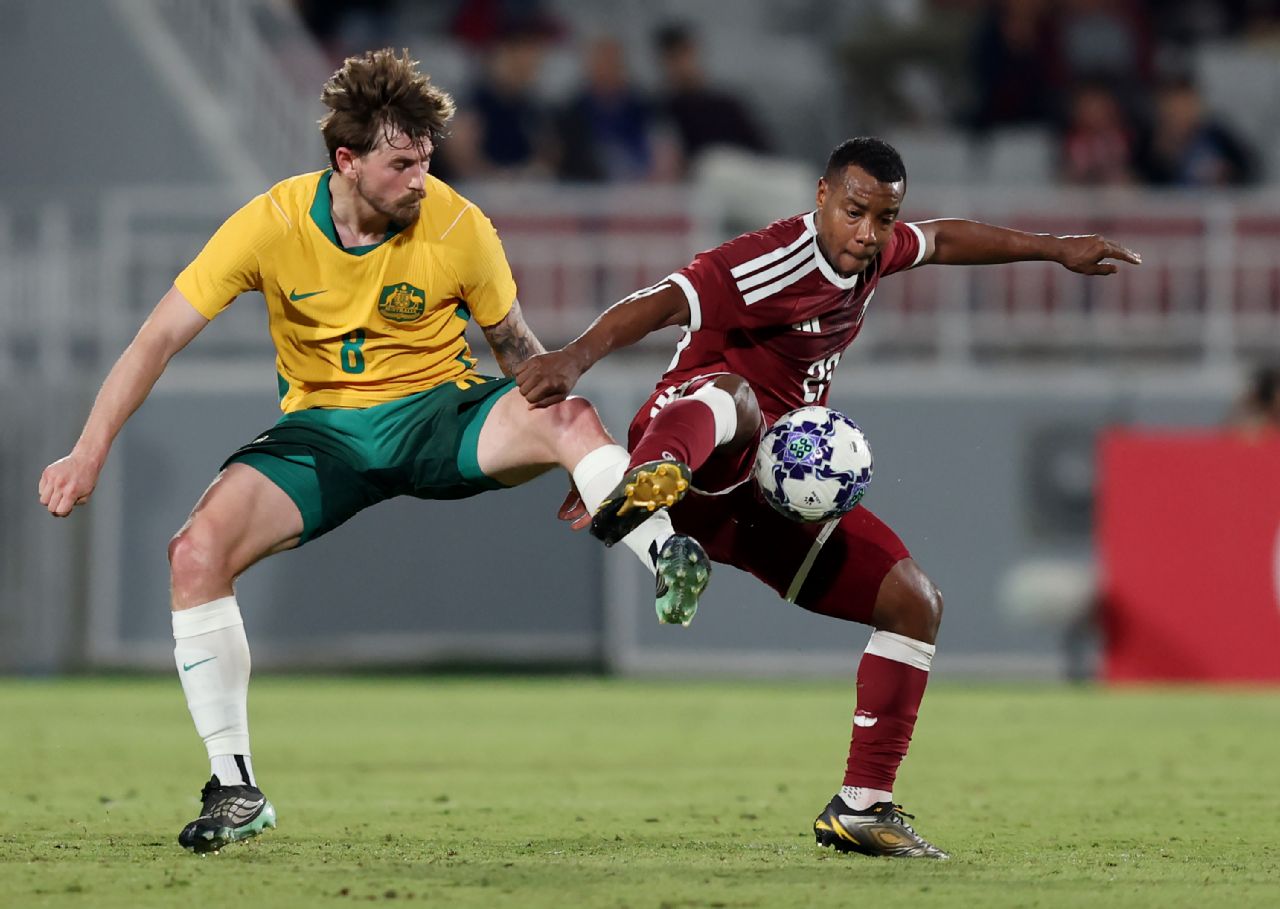
DOHA, Qatar - It's difficult to figure out exactly what the Socceroos' 3-0 win over Qatar might come to represent. The result and first-half, especially, are definitely positive; if you were an Aussie fan that has turned their brain off over the past few months and was just tuning in for a good time, you would have come away feeling pretty chuffed. But for those of us paying attention, it fits into a broader context, an almost purgatory-like situation Australia's men presently find themselves in.
But first things first, before the moroseness, the sunshine and rainbows. The Socceroos marched into Doha on Friday evening and defeated the two-time defending Asian champions on their own turf. That's good. After a positive window against Brazil in September, there were further signs of the team's maturation, too, with Riley McGree, Tete Yengi and Nestory Irankunda's goals all coming as a direct result of the team's press.
Even as the bench as emptied in the second stanza and four players made their international debuts - Sam Klein, Eli Adams, Kasey Bos, and Diesel Herrington - Australia was the clear physical best against a foe hailing from a West Asian region that has traditionally given them trouble.
"It was good to see the players who scored," said coach Tony Popovic. "To see Riley back starting a game for Australia, which hasn't happened in a while. Alessandro Circati could have scored as a centre-back. Young Paul Okon Jr went through as a six. So, we're getting the players in the right areas. Still a lot of work to do for us, but that was pleasing."
How the Socceroos' young group takes the next step in its development coming out of the FIFA World Cup has been a dominant topic over the past five months. Indeed, not since Charles Darwin took a cruise to the the Galápagos Islands has the phrase 'evolution' been bandied around more than it has been on this team. But if the Brazil series in September flashed signs that the unit was becoming something capable of much more than battening down the hatches against stronger nations, Friday offered suggestions of what they can be -- they're the big dogs.
Australia pressed well, they pressed aggressively, and they pressed successfully in Doha. They took enough of their chances to put the game to bed early, too, which is something that as little as six months ago one wouldn't have taken for granted. At times, it felt like they were flat out bullying Qatar and, as much as you might not want to see Little Jimmy doing so on the playground, that's a quality that you absolutely want to see from your football team when the opportunity presents itself.
"Even if the Asian Cup's [postponed] now, we saw ourselves as one of the favourites, one of the big nations," Yengi said.
"We have that confidence within the group. We've got a lot of players playing at a top level. We have to show that in the games that we play. We have to bully teams, and I think we did that."
Games like Friday, or, perhaps more accurately, first halves like Friday's, offer suggestions of the direction that the side could go as it turns the significant potential into realised talent. Because if the Socceroos are going to be Asia's best - which should be the goal - then it follows that they'll need to be able to instill the same kind of fear in opponents that Japan does; albeit their version will probably centre around things such as their starting XI honed in the furnace of the world's top leagues and built on a foundation of robustness and intimidation - every member of the Socceroos' spine on Friday at least six feet tall.
"All due respect to Qatar but I think we have a large emphasis on wining our duels," said McGree. "And if we can win more than the opposition, for the most part, we create more chances and we end up playing better football than them."
Of course, with that said, it should be noted that a lot of this was helped by Qatar being bad on Friday. Quite bad. Plenty of this was down to the Socceroos, of course - one shouldn't allow familiarity with their defensive resoluteness to obfuscate just how damn good they are down back - but just like Brazil fielding a heavily rotated squad in September, one can't just ignore certain factors just because it upsets the vibe.
The Maroons failed to register a single shot on target even as the Socceroos, by their own admission, sputtered in their shape and press. Fielding a side with an average age of 31 and almost exclusively drawn from the Qatari Stars League - which plays just a 22 games season and in which more than 50% of minutes are logged by foreigners - they couldn't match the intensity or physicality against a Socceroo starting XI largely made up of players being honed in the grind of European football.
Coming off the back of a disappointing Arab Cup and FIFA World Cup campaign and playing an XI with an average age of 31 on Friday, one can see why there are fears of stagnation and regression and pressure on boss Julen Lopetegui.
Of course, for vastly different reasons, Popovic's future is under a cloud, too. And that brings us back to the almost existential conundrum that presents when attempting to analyse this game, and will present against Jordan next Tuesday.
Because how much, in the long run, will this game matter? This window was supposed to be about preparing for the Asian Cup but now with that tournament's postponement to late 2027 these games fall almost anachronistic; fixtures that wouldn't be occurring if organisers had the benefit of hindsight.
And while Popovic and Football Australia have been quick to point to the opportunity to blood new players and further grow the team during the 11 months of the Asian Cup's postponement, how much of this window will carryover if Popovic opts to depart at the conclusion of his contract next March? If it's Kevin Muscat, John Aloisi, Football Australia caretaker supremo Trevor Morgan, or someone else in the dugout next time, how much of the present vision will end up discarded?
It's a cloud that will hover over the team until a resolution is reached, with its own quirks and questions arising as a result. The coach opted to start close to a full-strength XI in this game, for instance, but we can't know what that means. Is it a sign he's staying? Or is it one that he's leaving? Further, are big wins more likely to make him stick around, eager to see how far the team can go? Or do they risk raising his stock in club level to the point where Football Australia can't keep him?
Will this game come to be seen as a building block? Popovic's farewell? Or friendlies that friendlied? In truth, only time will tell. Until then, maybe we'll have to learn to stop worrying and love the Popaball.